Graeme Brown’s Reputation Takes Another Beating

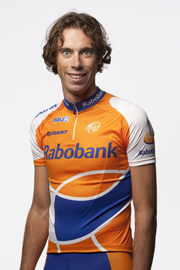
Australian cyclist Graeme Brown, never a popular man in the peloton, has made damning admissions that are certain to destroy his career in Europe.

Brown has been involved in controversy before. In 2004  he survived claims by disgraced track cyclist Mark French that Brown and other renowned Australian riders at the AIS  regularly injected “vitamins and supplements”, some of which were later found to be banned substances.

 And during his road career he has been constantly admonished by fellow sprinters for an overly aggressive style (which included attempting to run down an official at the recent Jayco Bay Classic).

And now this. On his team Rabobank’s website where his Dutch teammates list as their favourite food such delicious sounding European delicacies as Sauerkraut with smoked sausage, Semmelknodel and Tortilla de patata, Brown admitted to a preference for …”Steak”

The majority of Rabobank riders also chose red wine, or at least strong coffee, as their favourite drink. One of them, a Bram Tankink, who loves to eat “carpaccio of white truffles”  – the reason he hasn’t won a race or stage since 2005 –  was careful to point out “decent” red wine . 

Brown, already embarrassed by his food admission, was then asked about his drink of choice. Through quivering lips he squeaked: “Pure Blonde!” Crying, and handcuffed he was led away by Rabobank team management. His contract has been terminated and his name is now dirt in Europe.

Admittedly he wasn’t the only one. Jos van Emden who loves “milk and historical movies” was also given the flick.

This chap was shown the door too:-
Ironically, Robbie McEwen, one of Brown’s opponents and personal enemies, found himself in a similar situation with his Belgian Lotto team in 2008. Questions over his taste and good character were raised after  teammates noticed him avoiding Belgian ales. Those suspicions were confirmed when Robbie’s wife was sprung preparing a chicken parmigiana (defrosted Steggles chicken fillet, tin of Ardmona tomatoes, and  2 Kraft Singles) in the family home in Brakel. Lotto officials then raided his house on the Gold Coast uncovering a slab of Carlton Cold and a couple of empty VB stubbies in the carport.   

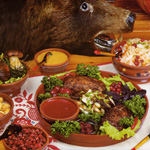
His new Russian outfit, Team Katusha, have allowed Robbie to drink Carlton Cold, the most tasteless beer in the world, on condition that he eats bear meat cutlets.  
Teatime at the McEwens

Awfully Remote Birthplace Key To Cricketing Greatness

According to the QI Book Of The Dead, your chances of being famous are enhanced significantly if your father is dead or absent.

Growing up in the middle of nowhere helps too – only three members of the current Test team were born or raised anywhere near one of the major cities. In fact the birthplace of each member (Phillip Hughes as 12th man) is on average 274 kms from the CBD of a major city. And this is despite the fact that two thirds of the population live in the major cities and a greater number of city kids play cricket than their country cousins.

Admittedly, I listed the birthplace of batting prodigy and bogan Ricky Ponting as being 165kms from Hobart because Launceston isn’t classed as a major city (the Cricket Australia National Cricket Census doesn’t even rate it as metro). On the other hand, Hobart isn’t really a major city either which puts him 429kms from Melbourne.

What is it about living on a banana plantation or in a combine harvester that makes country boys overrepresented in elite ranks? Is it the good weather and endless space , there not being a decent beer, coffee, or cinema in sight to distract them from meticulous continous practise and dreams of Test match glory? Or is it just kids desperate to escape a tedious hellhole?

Either way, they’re out the front of a country fish and chip shop in a Boags singlet chewing on a greasy piece of flake one minute, and lunching at Doyles in a Cricket Australia suit the next.

The greatest ever batsman was born in Cootamundra, 400kms inland from Sydney and then raised in Bowral. Young Donald, living in his parents home ( lace curtains, bone china tea sets and a religious silence broken only by the ticking of an antique clock echoing off the polished furniture) passed hot summer days among creaking windmills belting golf balls into a brick wall.

There are Bradman museums in Bowral and Cootamundra and a plaque attached to a Stringybark by the Hume Highway proclaiming: “Young Donald Bradman moved his bowels here during his family’s move to Bowral”.

Fellow Bowral resident, the writer and creator of Mary Poppins P. L. Travers, spent her childhood escaping the dreadful tedium of the place by imagining floating away with an umbrella.

Apparently the town has become more lively in recent times but that’s going to change now that Bryce Courtenay has moved in.

A place called Wondai is 250kms from Brisbane and a good book. It has a population of just 1400 but has still produced two Test cricketers: Carl Rackemann and Nathan Hauritz. There is also a good chance of inbreeding hence why Chad Morgan was born there too.

Marcus North was a relatively close 56kms from Melbourne in the “regional” suburb of Pakenham which marks “the end of the suburban electrified train service”. It was the end of the line alright – desolate flatlands and an abbatoir. As soon as he was able Marcus left town on the back of a Steggles Chicken truck.

Travel 100kms further east and you come to Peter Siddle’s brown coal town of Morwell. Its name comes from the aboriginal phrase ‘more willie’, the catchcry of the local women since all the male sporting stars left for the big city.

Phillip Hughes was spawned on the banks of the Nambucca River, spending his teenage years on the John Deere stand at the Macksville Show.

Are city players discriminated against by rural-type selectors, or do trust funds and shopping for hair straighteners undermine their development?

Simon Katich was dropped when the selectors found out he was born too near (27kms) to Perth and was only reinstated after he pointed out Middle Swan was a ”rural suburb”.

Stuart Clark (Sutherland, 26km) appeared to be unpopular despite his excellent Test record. It may have been his urban roots; or his reading material.

Ponting: “Hey Stu, what are you reading?”.

Clark: “Refinancing and High-Yield Bonds”

Ponting: “Hey Sidds what have you got there mate?”

Siddle: “Zoo Weekly. Hey Punter there’s a great piece here on ‘Laura’s Norks and Crannies’!”

Peter Siddle in. Stuart Clark out.

Stuart MacGill was an inner city product (2 kms) and was only ever selected reluctantly. Admittedly it could have been because he can be a bit of a knob sometimes. Also the neglected Brad Hodge was conceived just 18 kms from Melbourne.

We often hear: “He hails from the high country” or “The kid was raised in the Northern Rivers”. Will we ever hear: “He grew up in the Shangri La Hotel while his dad was CEO of Rio Tinto.”?

Published on The Roar

https://www.theroar.com.au/2010/01/27/awfully-remote-birthplace-key-to-cricketing-greatness/

Christmas Alarm Bells In Doncaster

The fire alarm at Doncaster Shoppingtown, situated in a suburb of Melbourne, works piercingly well, spearing off the marble tiles floors.

Unfortunately the PA system can’t match it. Its distressed voice (“There is no need to PANIC! Everything is ALRIGHT! Sorry for any INCONVENIENCE!”) battles its own static and the unrelenting screaming siren.

Suddenly, the Christmas cheer is seared off the Doncastrian faces.

The demographics of this suburb comprises big earning men and their big spending wives.

One of the latter I see bending forward to look at diamond embedded brooches when she becomes stilled on her stilettos (she’s a goner if there’s a fire), her face encrusted with fret.

These wealthy-by-marriage women, protected for most of their adult lives from the elements, from cheap synthetic fibres, and the ungodly stench of rubber in Kmart, appear to be confronting fear for the first time.

One has neat bobbed hair and a faux Navy officer jacket with the big gold buttons. I imagine her in the navy and all this screeching belonging to diving Kamikazes and exploding ammunition stores and her groaning ship, shot full of holes, plunging completely vertically into the depths. Would she stand proud saluting or leap shrieking into the oil doused fire ridden sea?

If a major fire had taken hold in the shopping centre it would not have been a pleasant spectacle. The rush to the exits – Tom Ford parfum igniting necks and Estee Lauder foundation melting faces – accompanied by the clicking and clacking of Jimmy Choo heels on the light reflective but spectacularly slippery floor.

And those that make it to the stairwells risk – if they can’t keep the mortal dread under wraps and fail to out bustle their equally impractically attired competitors – undignified and fatal collisions with each of the raggedly finished concrete steps.